When Nothing You Try Works, Make Room for What Jesus Can Do!

There is a particular kind of exhaustion that comes after trying everything you know to try. You have reviewed the bills again, sent another application, made another phone call, apologized again, searched for another solution, followed the advice, and prayed until you no longer know what words to use. Yet the problem remains.
The relationship is still strained. The health concern is still frightening. The business is still under pressure. The family still needs more than you feel able to give. The answer you hoped would come has not arrived.
At some point, your effort begins to feel like rowing against a current. You keep moving, but you are not getting anywhere. What do you do when every familiar option seems exhausted?
You make room for what Jesus can do.

Why the End of Your Ability Is Not the End of Your Story
Making room for what Jesus can do does not mean pretending the problem is small or refusing to take responsible action. It does not mean neglecting medical care, financial planning, wise counsel, personal safety, or necessary conversations.
It means releasing the exhausting belief that everything depends on you.
When you make room for Jesus, you begin moving:
- From exhaustion to openness
- From panic to discernment
- From isolation to receiving help
- From repeating failed methods to considering a new strategy
- From controlling every outcome to trusting Jesus with the timing and result
This shift matters because the end of your ability may become the place where you notice what you could not see before. Jesus may work through an unexpected person, an unusual method, an opportunity, a new strategy, practical provision, a protective closed door, or a change in perspective.
You do not have to manufacture the answer. You do need to remain open to the way Jesus chooses to reveal it.
Surrender is not the same as giving up. Giving up says, “Nothing can be done.” Surrender says, “I cannot do everything, but Jesus can lead me in what comes next.”

When Your Effort Has Reached Its Limit
Jesus understands the pressure you are carrying. He sees the bills, the health concerns, the family responsibilities, the workplace stress, the unanswered prayers, and the private disappointment that you may not have shared with anyone.
Reaching the end of your strength does not mean you have failed Jesus. It means you are human. Even faithful people reach moments when their resources, wisdom, energy, and solutions are not enough.
The good news is that Jesus is not limited by what has limited you.
He may not respond in the way you expect. He may not change the situation immediately. His timing, method, and response belong to Him alone. But He can meet you with direction before the circumstances change. He can give you clarity before provision arrives, courage before the door opens, or wisdom before you know exactly how the story will end.
Not every hardship was caused by Jesus, and not every delay has one simple explanation. Still, Jesus can redeem what He did not cause. He can bring meaning, strength, protection, direction, and new possibilities into circumstances that have left you discouraged.
Three Biblical Pictures of What Jesus Can Do When You Cannot
One of the clearest patterns in Scripture is this: people reach a real limit, and Jesus meets them there with what they do not have on their own. That does not mean He always responds in the same timing or with the same visible outcome. It does mean your exhausted edge is not a place Jesus avoids.
1. Peter after a night of catching nothing
In Luke 5:1–11, Peter and the other fishermen had worked through the night and caught nothing. Their work was familiar. Their equipment was available. Their experience was real. Still, their nets were empty.
Jesus told Peter to put out into deep water and let down the nets again. Peter answered, “Master, we’ve worked hard all night and haven’t caught anything. But because you say so, I will let down the nets.”
Peter was exhausted, but he remained open to an instruction that challenged his recent experience.
Sometimes Jesus does not merely give you more strength for the old method. Sometimes He gives you a different instruction, strategy, timing, or perspective.
That does not mean every failed business effort will suddenly produce extraordinary financial results. It does not mean every repeated attempt should continue indefinitely. It means Jesus may reveal that your next step is not simply “try harder.” It may be “listen differently.”
Peter had to acknowledge that his effort had produced nothing. Then he had to make room for the possibility that Jesus saw what he could not.
The catch that followed revealed Jesus’ authority, but Peter’s deeper transformation was also important. He learned that his future could not be measured only by one disappointing night.
Your empty net may represent a failed plan, a rejected application, a stalled project, or a season when your work has not produced enough. Let Jesus show you whether you need perseverance, a new method, wise counsel, or permission to move in another direction.

Peter’s story shows what it looks like when Jesus gives direction after fruitless effort. The next example shows that this pattern is not limited to fishing, work, or career disappointment. Sometimes the pressure is financial, family-based, and urgent.
2. The widow when almost nothing was left
In 2 Kings 4:1–7, a widow cried out because her husband had died, debt remained, and creditors were coming to take her two sons as slaves. She was not dealing with inconvenience. She was facing loss upon loss: grief, financial pressure, and fear that her family would be torn apart.
By that point, she could no longer earn her way out quickly enough, protect her sons by her own strength, or create resources she did not have. When Elisha asked what she had in the house, her answer revealed how limited things were: only a small jar of olive oil.
That is what makes the story so powerful. God did not begin with abundance in her hand. He began with the small thing she almost could have dismissed.
Elisha instructed her to borrow empty jars from her neighbors, and not just a few. Then she was to go inside with her sons and pour oil into every container. She had to participate in the process. She had to ask for help. She had to gather capacity before she saw provision fill it. She had to pour in faith from a supply that looked too small to matter.
And as she poured, the oil kept flowing until every borrowed container was full.
What could she no longer do?
- She could not erase the debt by herself.
- She could not guarantee her sons’ safety through her own resources.
- She could not multiply what she did not have.
- She could not solve a large crisis with visible means alone.
What did God do that she could not?
God worked through the little oil she had, through prophetic instruction, through borrowed containers, and through her willing participation to create provision she could never have produced alone. Afterward, Elisha told her to sell the oil, pay her debts, and live on what was left.
What changed?
- Imminent loss was interrupted.
- Her small resource became part of a larger provision.
- Her household moved from panic toward stability.
- She received a way forward, not merely a comforting word.
How does this support the article’s Jesus-centered message today? Jesus is the same Lord who still knows how to meet people at the end of their resources with wisdom, direction, and provision. This Old Testament account reminds you that when you make room for His direction, He may work through what seems too small, through help from others, through practical steps, and through obedience that does not make sense at first.
That does not mean you are guaranteed the widow’s exact financial outcome. It does not mean every debt disappears supernaturally, or that every borrowed-container moment ends with overflow. It means you should not despise the small thing, the wise instruction, the community help, or the practical participation Jesus may use as part of your provision.
Sometimes making room for Jesus looks like:
- Being honest about how serious the need is
- Not hiding from trusted help
- Using the small resource you still have
- Following clear instruction step by step
- Preparing space for provision before you fully see it
And that same openness becomes even more important when the problem is no longer just disappointing or financially urgent, but deeply painful.

3. Jairus when the situation moved beyond human ability
In Mark 5:21–43, Jairus came to Jesus because his daughter was seriously ill. He had already reached the point where position, concern, urgency, and love were not enough. He could not heal her. He could not secure the future he wanted for her. He could not force the outcome to change.
Then the situation became even worse. While Jesus was still on the way, messengers arrived with devastating news: Jairus’ daughter had died. In other words, Jairus was not simply facing delay. He was facing the collapse of what he had hoped Jesus would do in time.
The people around him immediately shifted into human logic: there was no point in troubling Jesus anymore. As far as they could see, the opportunity had passed.
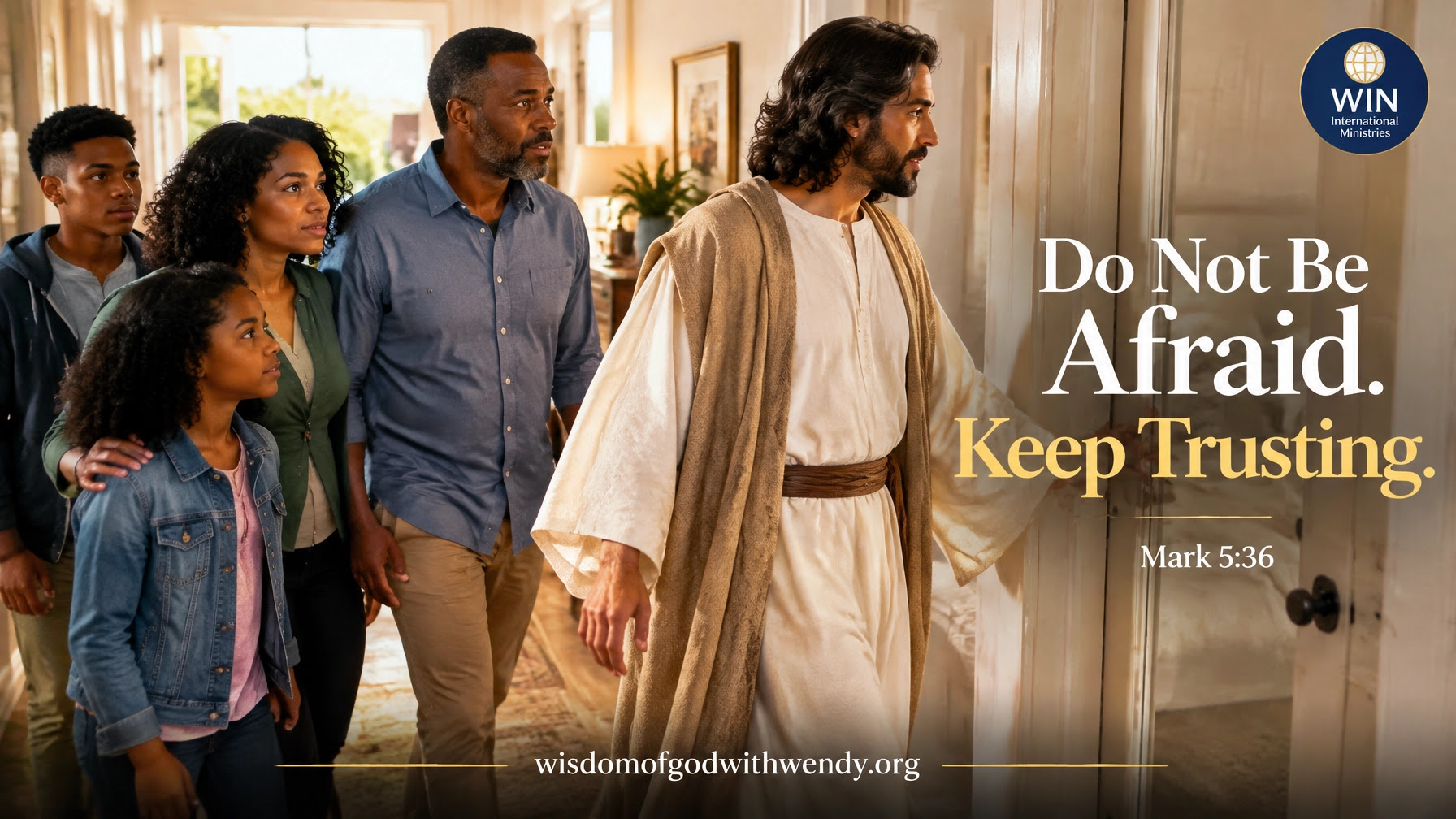
Jesus answered that hopeless conclusion with a different word: “Don’t be afraid; just believe.”
That response matters. Jairus could no longer do anything to reverse what had happened. He could not restart life. He could not undo the news. He could not argue the situation back into possibility. But Jesus could walk into a place everyone else had mentally closed and reveal authority beyond the limit of human ability.
Jesus went with Jairus, entered the house, took the girl by the hand, and told her to get up. What Jairus could not do through love, influence, urgency, or grief, Jesus did through His authority.
What changed?
- A situation people treated as finished was no longer final in Jesus’ presence.
- Fear was confronted by Jesus’ invitation to trust Him.
- A father who could not fix the crisis was not abandoned in it.
- The house that had filled with mourning became a place marked by Jesus’ power.
What can you learn from this without forcing the same outcome onto your life?
- Some situations truly do move beyond what you can solve.
- The voices around you may decide too quickly that nothing else can happen.
- Jesus is able to enter places where your strength, timing, and influence stop working.
- Faith is not pretending loss, pain, or limitation are unreal. Faith is continuing to bring the real situation to Jesus.
This story does not promise that every loss will be reversed in the exact way or timeframe you want. It does show that when your ability ends, Jesus still has authority, direction, and presence to bring into the moment. Even when you cannot repair the circumstance, you can still keep company with Jesus inside it.
What About Your “I Can’t”?
Perhaps your words sound like these:
- “I can’t fix this relationship.”
- “I can’t pay these bills.”
- “I can’t find a job.”
- “I can’t keep carrying my family.”
- “I can’t heal from what happened.”
- “I can’t save this business.”
- “I can’t make this person change.”
- “I can’t keep pretending I’m okay.”
Jesus does not answer these statements with shallow slogans. He meets you with truth, compassion, and direction.
Making room for Jesus may involve a budget, a counselor, a doctor, a lawyer, a support group, a boundary, a job strategy, a difficult conversation, or a new business plan. It may involve receiving practical help instead of hiding your need.
It may also involve accepting that you cannot make another person change. Jesus may lead you toward a healthy boundary rather than another attempt to persuade someone who refuses responsibility. He may provide emotional healing gradually rather than instantly. He may give you strength to leave an unsafe situation rather than strength to remain in it.
Jesus’ help may look different from what you expected, but different does not mean absent.
How Do You Make Room for What Jesus Can Do?
1. Tell Jesus the unedited truth
Stop editing your prayer to sound stronger than you feel. Tell Jesus where you are angry, afraid, confused, disappointed, or exhausted. He already knows, and honesty creates room for a real relationship rather than a performance.
2. Name what you have tried
List the steps you have taken. This can help you separate responsible effort from frantic repetition. You may discover that one method needs to be adjusted, completed, or released.
3. Identify what is and is not within your control
You can control whether you seek help, tell the truth, set boundaries, care for your health, and take the next wise step. You cannot control another person’s choices, every financial outcome, the timing of every opportunity, or the entire future.
Give Jesus what is beyond your control.
4. Ask what you may be missing
Ask Jesus whether there is an unexpected person, resource, opportunity, strategy, or perspective you have overlooked. This is not a formula for forcing Him to act. It is a way of becoming attentive.

5. Remain open to qualified help
Faith and wise support belong together. Seek medical, mental-health, financial, legal, relational, or pastoral assistance when appropriate. Do not abandon responsible care or tolerate danger in the name of waiting for a miracle.
6. Take the next wise step
You may not receive the entire plan. Jesus may provide enough light for one step. Make the call. Submit the application. Rest. Set the boundary. Ask for help. Follow the instruction you clearly understand.
7. Release the timing and outcome
You can obey Jesus without controlling the result. His timing and method are His alone. Your responsibility is faithfulness, not manufacturing an outcome.
Questions to Bring to Jesus
In prayer, ask:
- What am I still trying to control?
- What have I assumed must happen for this to be solved?
- Is there an unexpected person or resource I have overlooked?
- Do I need a new strategy?
- What do I need to release?
- What support should I receive?
- What is the next faithful step?
- What might Jesus be showing me through this closed door?
While you wait, rest without calling rest failure. Continue in prayer and Scripture. Document facts instead of treating fear’s predictions as certainty. Care for your sleep, nutrition, hydration, vitamins or minerals with qualified guidance, and mental and physical health. Avoid predatory schemes and reckless shortcuts that promise instant answers.
Watch for gradual movement. Jesus’ response may be internal, practical, relational, or circumstantial. He may give you a new idea, calm in pressure, a trustworthy person, a needed boundary, provision, protection, healing, courage, or a closed door that keeps you from harm.
If severe depression, inability to function, or thoughts of self-harm are part of your experience, seek prompt qualified or crisis support. Receiving help does not contradict faith.
Jesus Still Has a Way Forward
Your inability to fix everything does not mean Jesus has no way forward. The end of what you can do may become the beginning of what Jesus reveals, not because you have found a perfect formula, but because you are no longer insisting that the entire solution must come from you.
Jesus may change the situation. He may strengthen you within it. He may redirect you out of it. He may show you that a burden was never yours to carry alone.
You do not have to manufacture the outcome. Make room for His direction, His wisdom, His provision, His protection, and His timing.

Let’s Pray Together
Jesus, we bring You the places where nothing we have tried seems to be working. You see the bills, the health concerns, the family pressure, the relationship pain, the workplace stress, and the private fears we have carried quietly.
Please meet us at the end of our strength. Give us wisdom to know what belongs to us and what we must release. Show us the next faithful step. Open the right doors, provide trustworthy support, reveal helpful resources, and protect us from harmful shortcuts.
Jesus, give us discernment if You are leading us toward an unexpected person, a new strategy, a difficult boundary, or a different opportunity. Give us courage to follow Your instruction even when we do not understand the whole path. Bring healing where healing is needed, strength where the waiting is long, and peace where fear has become loud.
We surrender the how, the when, and the where to You. Help us remain responsible without becoming frantic, hopeful without pretending, and open without abandoning wisdom. Remind us that our limitations are not greater than Your ability to lead us.
Amen.
Take heart: you may not see the way yet, but Jesus is not limited to the ways you have already tried. Keep listening, keep taking wise steps, and keep making room for Him.
For more encouragement, prayer, and biblical wisdom, visit Wisdom of God with Wendy and follow WIN International Ministries on our social media networks.